The Importance of Harmony in Ceramic Conservation
- Elizabeth Wells
- Sep 13, 2022
- 5 min read

As conservators, we are always trying to ensure we are doing justice to an object; by not drawing attention to our efforts and maintaining aesthetic and textural integrity. By doing so, we hope to achieve harmony between our conservation work and the item itself. We often go by the ‘6-foot 6 inch-rule’ (something many museums and public collections use), in which conservation is easily recognised from 6 inches but hard to spot from 6 feet away, matching colour tones, accurate texture in raking light, and the overall shape of the object, so as not to draw attention from afar.
Already at West Dean I have come across a number of items that have not always passed the ‘6-foot 6 inch-rule’ (sometimes due to the limitations of historic repair materials, and sometimes due to the methods of past repairers), it has been my job to assess these past repairs and, in some cases, to create a more sympathetic restoration. With this in mind I am often mindful of my own work on freshly broken items, and how will future conservators evaluate my work?
The Doulton Lambeth Tulip Vase and Overfilling

There are a number of factors that can lead to disharmony in conservation. One of the most common is the scope of materials available at the time of repair, which can lead to problems of over application of filling materials, and misaligned bonds. The range of options available to ceramic conservators today allow for more tailor made solutions to damaged items.
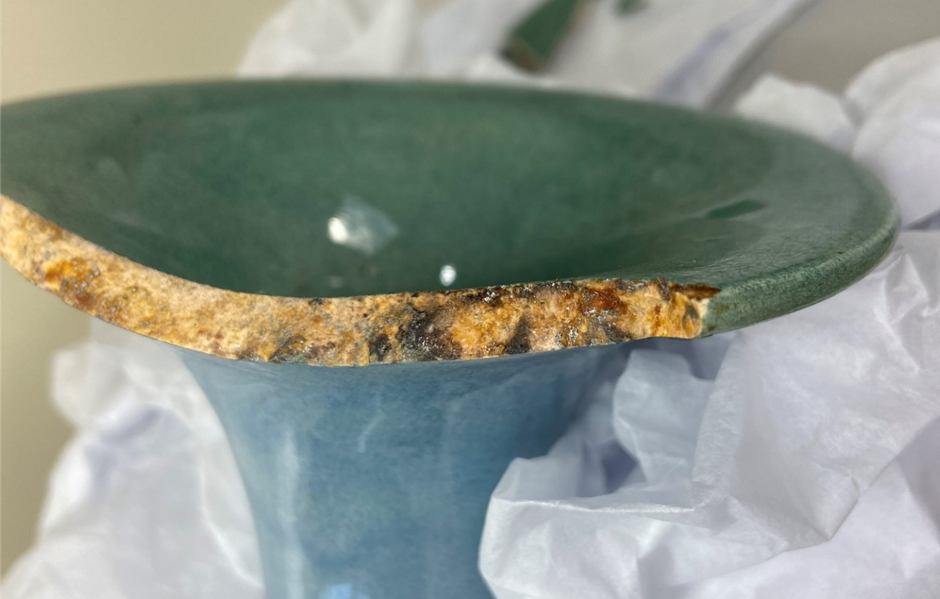
The Doulton Lambeth Tulip stoneware vase pictured above arrived on my bench with very evident historic restoration work. While much of the vase was in excellent condition, one side of the rim had broken into 4 shards and had been reapplied using an assortment of adhesives which took 9 hours of swabbing and a desiccator to remove . The sheer amount of adhesive on these break edges meant the shards were out of place and sticking out markedly from the rest of the rim. The bond lines had also been filled with a plaster material that had been generously applied up and over the bond to sit on the surface of the vase creating an unattractive and very obvious repair.

A huge amount of this vase’s aesthetic appeal is through the graceful tulip shape of the rim, and the blue and green watercolour crackle glaze. The previous repair damaged both the smooth lines of the profile, and the colour change was very evident from both 6 inches and 6 feet away! To restore the beauty of the design, it was important to remove this past repair and to try to conserve in a way that worked in harmony with the vase. This was done by getting a tight bond for the adhesive and careful retouching to match the colour, The shards bonded and filled to the rim of the tulip vase in a tighter alignment to draw less attention to the conservation work texture of the glaze.

The Riveted Spanish Plate


Similarly, to the vase, previous repairs on a 19th Century Spanish tin-glazed earthenware dish, seen in figures 6 and 7, are a challenging collection of mixed adhesives and techniques, with misalignment of shards and overfilling, as well as metal rivets and corrosion. This plate tells us a lot about past repairs, methodology and the materials available to conservators over a broad period of time. Most notably, the use of rivets in historic ceramic conservation is particularly exciting, demonstrating a kind of ‘function over form’ approach to conserving items in the past, and something that can sometimes add aesthetic value to the piece. The objective in this case is actually recognising the disharmony of the previous repairs and attempting to incorporate them into the conservation treatment plans.
Although there is something so striking about the way this plate has been treated over the years, requiring acceptance and minimal intervention, there are some obvious areas where more harmonious and sympathetic conservation is appropriate. It is generally more desirable to avoid leaving any fill material on top of original ceramic, although occasionally this cannot be avoided, and on this plate, there are clear areas on both the front and back where the unpainted fill is obscuring original paintwork underneath. If the decision were to be made to preserve the rivets, and much of the past repairs, there is still a case to be made to remove any unnecessary overfilling that affects the overall design of the plate. The key here is to both respect the life that the plate has led, which includes the historic repairs, but also to try to ameliorate excess, instability and unnecessary damage caused by those repairs.

The Japanese Mt Fuji Plate

Sometimes it is as important to recognise when to stop conserving as it is to conserve. The delicate eggshell porcelain plate seen in figure 9 arrived on my bench broken into 7 larger shards, and tens of tiny fragments. There were no missing areas and no previous repairs. The hand painted, Kutani style of decoration has meant there are tiny imperfections to the paintwork, which affects the conservation choices I have to make. After bonding, it was clear that there were tiny areas of losses to the glaze and paintwork. I discovered that, after filling with the body colour, these losses did not stand out on first glance as there were already patches of missing colour in the original artwork. In this case the ‘6 foot 6 inch’ rule gives a clear rationale for leaving these fills untouched.
If the eye is not immediately drawn to the conservation work, it is arguable that minimal intervention has been achieved, and the job is done.

Overall
This collection of items is only a snapshot of some of the items we work on at West Dean, and it shows the breadth of the decisions we have to make. The choices conservators make on how to treat objects isn’t an exact science, and they can be fuelled by the work that has already been done on an item. What underpins all of our decisions is the respect for the object and an understanding of the key significance of the pieces.
References
ODDY, A. (ed.) (1992) The art of the conservator. London: British Museum.
BUYS, S, OAKLEY, V (1993) Removal of previous restoration materials in The Conservation and Restoration of Ceramics, London: Routledge
The Wallace Collection, (2022) Conservation Projects, [Online] Available at: https://www.wallacecollection.org/art/conservation/ Accessed 06/05/2022 [1] ODDY, A. (ed.) (1992) The art of the conservator. London: British Museum. [2] BUYS, S, OAKLEY, V (1993) Removal of previous restoration materials in The Conservation and Restoration of Ceramics, London: Routledge


Comments