Minton's Encaustic Tiles
- Elizabeth Wells
- Sep 13, 2022
- 7 min read

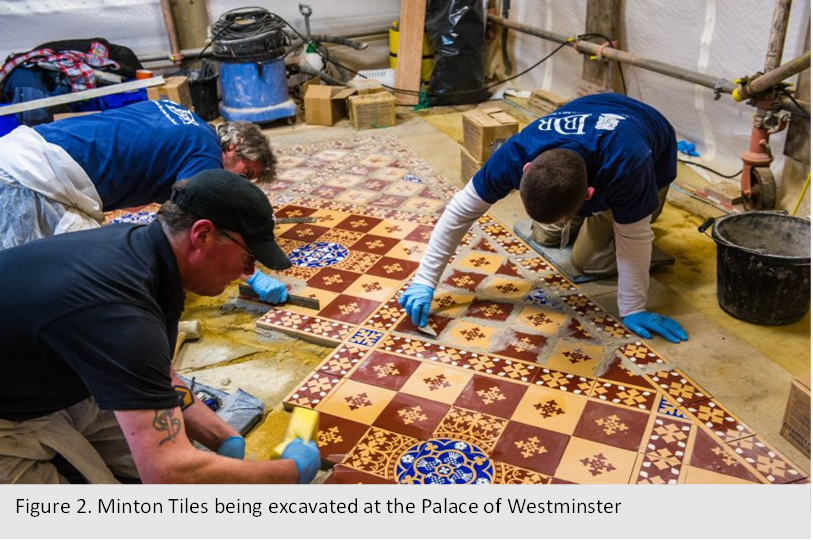
Designed by A.W.N Pugin and manufactured by Herbert Minton, the neogothic inlaid or ‘encaustic’ tiles that were laid in the Palace of Westminster in the 1840s (pictured in figure 1) demonstrate extensive deterioration, principally through footfall and bomb damage (UK Parliament, 2021). These tiles are valuable for both their aesthetic and manufacturing histories, and as a consequence a large-scale restoration programme began in 2010. Looking specifically at the tiles that were removed during this treatment (figure 2 shows the excavation of these damaged tiles) and by understanding the chemical and physical properties, the historic significance, and intended future use, it will be possible to propose appropriate conservation treatments and recommended continued care.
Historically, inlaid tiles were commonly used on royal buildings and churches around the 13th century. They fell out of style during the renaissance, only to be reintroduced during the gothic revival of 1817. When Pugin was commissioned by Charles Barry to design the interior of the Palace of Westminster, he turned to the Minton firm to establish a mass production method of encaustic tiling, featuring symmetrical designs in up to six colours. By 1860 Minton had created some 75,000 tiles for the Palace (Durbin, 1993), likely the largest tiling scheme ever undertaken in the world at that time (Aldrich et al, 1995). By 1968 the firm had merged with Royal Doulton Tableware Ltd and had ceased production on this style of tile, thus any created in partnership between Minton and Pugin are a significant part of history for the Palace, the Minton company and the neogothic movement.
The term encaustic is taken from the Greek to mean ‘burnt-in’ and refers to a style of tile where the pattern and colour variations are formed through different clay-body slips poured into moulds (figure 3).

Variations in these clay slips are used to create an array of styles and patterns. Specifically looking at the encaustic tiles of the mid-1800’s, these earthenware pieces are made of multiple types of clay; the first being the ‘core’, usually a red clay that has been lapped with grey to prevent warping during firing (J&B Austwick, 1980). This core colour is then impressed with a pattern and filled with a different colour clay slip. Earthenware clays used in encaustic tiles vary enormously in material composition, however they commonly fire at around 750-1,100°C, any higher and the clays may deform and break down. Because the firing temperature is relatively low in comparison to clays like porcelain, the minerals do not fuse as thoroughly, leaving the final earthenware item more porous than a hard paste object. Powder glazes are then fired onto the tile to fuse with the earthenware body to reduce porosity and allow for the tile to be placed in working areas with possible heavy footfall (Hawkins, 2020). Minerals can be added to act as fluxes to raise the firing temperature of the clay or for aesthetic purposes. Minton’s final tile was approx. 15x15cm and composed of a lower quality red clay sandwiched between higher quality buff, which prevented shrinkage and lowered manufacturing costs, but, because different clays were used to create designs, mineral compositions, firing temperatures and porosity differ across layouts. Some of the Pugin/Minton tiles featured up to six different coloured slips and were used extensively to decorate the hallways of the Palace of Westminster, an area of heavy footfall (Aldrich, M, et al, 1995). If the glaze is compromised, which is to be expected from working hallways, the tile is more vulnerable to damage as the porous layer is left exposed, this effect can be seen in the exposed clay areas where the glaze has chipped and dulled in figure 4.

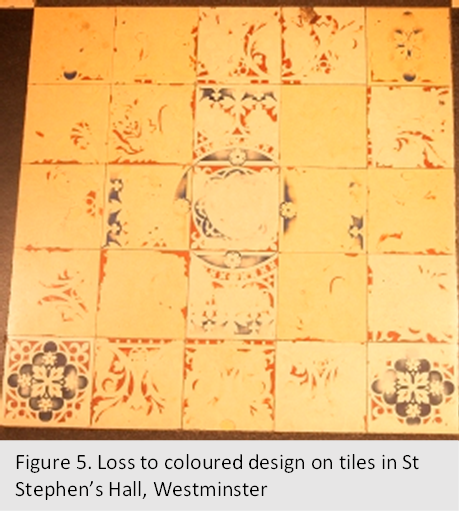
Understanding both the cause of degradation and the consequent processes of deterioration an object experiences is a crucial phase in the conservation process as it directs treatment methodology sympathetic to the item’s needs. Typical mechanical damage that is more likely to occur on low-fired bodies like the earthenware used by Minton and in environments of heavy footfall includes breaks and cracks, chips to the glaze, missing areas, glaze loss and surface abrasion (Buys, Oakley, 1993). Since different clays were used to create the heraldic decoration in the tiles, damage or wear would inevitably occur unevenly due to the different mineral compositions, resulting in each tile showing an undulating surface profile on the hallways and loss of colour across the designs, the green glazes used on many of these tiles are particularly vulnerable to surface abrasion (Durbin, 2015) (seen in figure 5.) The relatively simple design on these tiles means that any damage to pattern or colour has a substantial effect on the overall design. The surface abrasion and deterioration from the general use aside, there is also clear mechanical damage to many of the removed tiles, with chips and breaks revealing the red clay inner core. Added to this more conventional or expected degradation, the tiles in the Palace of Westminster also endured 14 separate air raids in 1940-41 (UK Parliament, 2021) and many therefore, experienced bomb, fire and smoke damage. The material properties of these tiles and the process of deterioration suggest a number of possible treatment options.
Despite the tiles removed as part of the 2010 restoration programme no longer needing to perform the utilitarian function for which they were created, they still hold significant historic value and should be treated as conservation objects for future display, education or private ownership. Looking specifically at the tiles removed for display in the V&A South Kensington Museum (seen in figure 1 and 6), principal recommendations for care includes cleaning, consolidating for stability, bonding, filling, and retouching if necessary. Before starting any treatment, it is essential to assess the condition of the ceramic body, any previous repairs, or weak spots like flaking or eroded glaze, and if there are any stains or residues (Corvaia, 2017). When cleaning the item, the porosity of earthenware provides a challenge for a conservator to avoid further staining or compromising the body of the tile; this is particular difficult for any areas of erosion to the glaze as the porous core clay is exposed. As these tiles were removed from a working building with heavy footfall, there is also concern about what materials might be in the break edges or abraded surfaces and the long-term effect this could have on the item. Cleaning would be done with caution around porous break edges and a dry clean with a brush would be an appropriate first step. Deionised water on swabs or a solution of non-ionic detergent e.g. LissapolTM in water can help to remove more stubborn dirt on vitrified areas. Solvents like acetone may also help to clean any surface dirt, though this must be tested on a small sample area first. It may also be possible to poultice with enzyme cleaners such as Bio-Tex or Laponite® to remove any ingrained staining in the body of the clay. As the tiles are held in a museum for education and display, it is important to avoid overcleaning and removing historic context but enough to stabilise and show the design. If the tile has broken into shards, the joining treatments should be reversible and as non-invasive as possible (ICON, 1999). Due to the body of these tiles, edge-to edge bonding with a thermoplastic resin such as Paraloid B-72 or Cellulose Nitrate, would be more effective than capillary action bonding with an epoxy resin, this process would minimise the risk of staining from the bonding agent flooding the porous clay with a more liquid adhesive like epoxy (Koob, 1986). Gap filling on these tiles may be an appropriate next step dependant on the damage to the tile. For some, the missing areas can show the clay and glaze layers that can give insight into their manufacture. If the tiles are to be displayed together in sequence (as in figure 6), filling any significant areas of loss can help show the visual grandeur of the patterns of tiles as they were when originally in situ. In order to gap fill, the area of loss should be consolidated to protect the porous body from absorbing the fill and possibly staining the item, a 10% solution of Paraloid B-72 in acetone would be recommended. A hard plaster such as TL Prestia Basic Alpha would mirror the porous, low-fired, material of these tiles, and matched colour fills with acrylics would then be used to mirror the design. Fills should be used sparingly, and only in areas where being left untreated would undermine the visuals of the tile, or the structural integrity; the Palace of Westminster is a working building and the conservation of these tiles needs to reflect that, the aim is not to make them ‘like new’ but to display the historic significance of the Minton tile in the neo-gothic movement (Richmond, 2015).

Many of the original Minton tiles that were first laid in the Palace of Westminster almost 200 years ago, have suffered extensive and varied mechanical damage. The existence of the degradation, through everyday wear and exceptional events, such as the bombings of WW11 demonstrates as important history of the tiles, their design and construction. By ensuring that as many original tiles as possible can remain in situ, the hallways can remain functional and also historically significant, while conserving the tiles that are unfit for practical use, a different history can be observed and learned from, one of manufacturing techniques, and the material impact of human interactions with an object.
Bibliography
“On Encaustic Tiles.” Art Journal (1851) University of Michigan Library. Web. [accessed 19/11/2021]
ALDRICH, M. Et al (1995) A.W.N. Pugin: Master of Gothic Revival. The Bard Graduate Centre for Studies in the Decorative Arts, New York
APPELBAUM, B (2008) Conservation Treatment and the Custodian/Conservator Relationship, CeROArt [Online] [accessed 19/11/2021] URL: http://journals.openedition.org/ceroart/445; DOI: https://doi.org/10.4000/ceroart.445
BERENDSEN, A. (1964) Tiles. A general history. London: Faber.
Building Conservation [Online] (2017) WATROBSKI, A, Encaustic Tiles at the Palace of Westminster, Available at: https://www.buildingconservation.com/articles/encaustic-tiles/encaustic-tiles.htm Accessed: 20/11/2021(Figure 2, Figure 3)
BUYS, S; OAKLEY, V. (1993) Conservation and Restoration of Ceramics, Oxford: Butterman Heinemann
CAPLE, C. (2000) Conservation skills: judgement, method and decision making. London: Routledge. Available at: https://doi.org/10.4324/9780203086261 [Accessed: 15/11/2021]
CORVIA, C (2017) Ceramics, Western Australian Museum: Government of Western Australia. Available at: https://manual.museum.wa.gov.au/book/export/html/75 Accessed 24/11/2021
DURBIN, L. (2015) Architectural tiles: conservation and restoration. 2nd edn. London: Routledge.
HAWKINS, R (2020) Pottery and Porcelain Restoration, A Practical Guide, Wiltshire: The Crowood Press
HORIE, C. V., 1987, Materials for Conservation, Butterworths, London.
ICON The Institute of Conservation [online] (2021) Icon Professional Standards, Icon Professional Standards and Judgement & Ethics, Available at: https://www.icon.org.uk/resources/standards-and-ethics/icon-professional-standards.html [Accessed 16/11/2021]
JONES, J. (1993) Minton. Shrewsbury: Swan Hill.
KOOB, S., 1986, The use of Paraloid B-72 as an adhesive: its application for archaeological ceramics and other materials, Studies in Conservation, vol. 31, pp. 7-14.
Premier Construction News [Online] (2021) Enhancing Parliament’s Encaustic Tiles: A Decade-Long Journey, Available at: https://premierconstructionnews.com/2021/06/14/enhancing-parliaments-encaustic-tiles-a-decade-long-journey/, Accessed: 20/11/2021 (Figure 2)
PUGIN, A. W. N. (1849) Floriated ornament. London: Henry G. Bohn. Via Smithsonian Libraries
RICHMOND, A. and BRACKER, A. (eds.) (2009) Conservation: principles, dilemmas, and uncomfortable truths. Oxford: Butterworth Heinemann. Available at: https://doi.org/10.4324/9780080941714 [Accessed: 20/11/2021].
UK Heritage [Online] (2019) Available at: https://uk-heritage.co.uk/shop/a-large-quantity-of-antique-minton-encaustic-floor-tiles-7m2-75-sq-ft/ Accessed: 19/11/2021 (Figure 4)
UK Parliament [Online] (2021) Bomb Damage, Available at: https://www.parliament.uk/about/living-heritage/building/palace/architecture/palacestructure/bomb-damage/ Accessed: 22/11/2021
V&A [Online] (2003) Object Record, Available at: https://collections.vam.ac.uk/item/O77827/floor-tiles-pugin-augustus-welby/ Accessed: 19/11/2021 (Figure 6)
V&A [Online] (2009) Object Record, Available at: https://collections.vam.ac.uk/item/O278141/tile-pugin/ Accessed: 19/11/2021 (Figure 1)
VAN LEMMEN, H, MALAM, J. (eds.) (1991) Fired earth: 1000 years of tiles in Europe. Shepton Beauchamp: Richard Dennis Publications.


Comments